DANCE STUDIES – GROUP B – 1st SESSION – OCTOBER 4, 2017
Introduction
Experimental tasks:
– Translate what someone (e.g. Kinga as a native Hungarian) has just said // a person speaks Hungarian (Virva), a person speaks Hungarian but having her eyes closed (Alejandra) // a person does not speak Hungarian (Gwen) // a person does not speak Hungarian and having her eyes closed (Justine)
What are our methods for translation?
-
Context (e.g. the teacher-student relationship limits the topics)
-
Prior-knowledge or Background info – we know that Kinga was travelling + Alejandra knows what bocadillo is
-
Body language
-
Vocabulary
– Dance that you are a cat and in search for a mouse // mimicking a situation/narrative
Quite clear, except what animal Ivona was.
– Dance the happiness emerges in a cat, when finding the mouse // expressive dancing
Pretty unclear – some of us decoded the movements as nervousness, anxiety, while others as joy and surprise.
What systems to be translated?
e.g. LANGUAGE
Is dance a language?
What is language? Is a language/dance for communication? All types?
From Kinga’s MA thesis on Gaga:
‘The Swiss structural linguist Ferdinand de Saussure, claims that language is a system, but its abstract systematic rules and conventions (LANGUE) should be distinguished from the examination of the langue’s personal usage (PAROLE). It is inevitable that Gaga is a system as well, which operates with clear movement intentions (~langue) through the given instructions and that it became realised in an individual way (~parole). Therefore this distinction is similar to what the Norwegian ethnochoreologist Egil Bakka understands under the notion of CONCEPT and REALISATION (fig. below). ‘The concept enables dancing people to dance a dance according to norms, to recognise it when other dancers do it,and, to some degree, to talk about it’, while ‘the realisation makes dance available perceptually’. A description can be made only of what the dancers are actually doing, while what they ought to be doing can be summarised in a separate prescription.
Until this point it can be said that the label “language” can be applied to Gaga. Yet parole, the individual phenomenon of language that manifests in speech acts, the term and theory which was developed by the British language philosopher John Langshaw Austin. The elementary base of the speech act is the ‘locutionary act’. A locutionary act is realised in a phonological level, it is grammatically structured and regarding semantics, has a definite meaning. The locutionary act does not work for the purpose of communication, but it has a meaning. When sentences are said in not a socially valid verbal action, so for example as instances at a foreign language class, can be counted as locutionary act situations.
The argument of American language philosopher Nelson Goodman, and discussed by Joseph Margolis, is that art works are symbol systems, but not languages. Accordingly, all Gaga movements done by the class participants have certain referential functions, since they are personal representations of the previously given instructions, but still they denote nothing. Therefore I feel it is problematic to use the term “language” on Gaga, moreover because of its not (yet) formalised nature, so for this [discussion] it will be referred to as a “system”.’
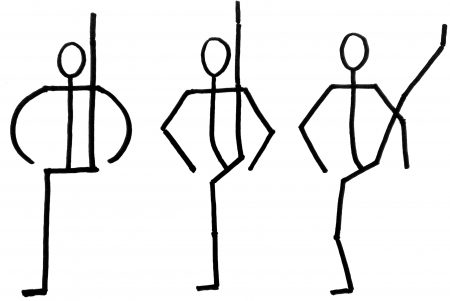
There are signs based on conventions but not having the intention to communicate for instance traditional costumes (unstable, temporary signs). Is dance like this?
Translation studies in a nutshell
– Word-to-word or sense-to-sense translation:
Cicero from The Best Kind of Orator (55 B.C.E.):
‘I translated the most famous orations of the two most eloquent Attic orators, Aeschines and Demosthenes, orations which they delivered against each other. And I did not translate them as an interpreter, but as an orator, keeping the same ideas and the forms, or as one might say, the "figures" of thought, but in language which conforms to our usage. And in so doing, I did not hold it necessary to render word for word, but I preserved the general style and force of the language. For I did not think I ought to count them out to the reader like coins, but to pay them by weight, as it were.’
– Translation as cultural practice (since the late 1990s)
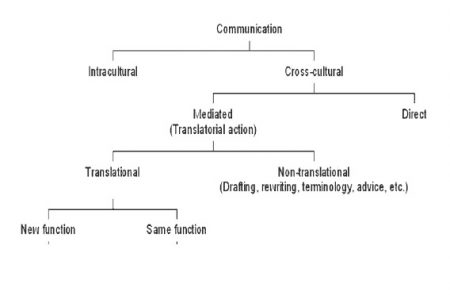
– Ut interpret vs. ut orator
– Formal correspondance (the form of the translation corresponds to the original text) vs. dynamic equivalence or cultural adaptation (same effect on the original and new reader)
E.g. Agnus Dei (lamb of God) told to eskimos… seal of God?!
'It’s raining cats & dogs.'
'Woke up on the wrong side of the bed etc.'
– Documental vs. instrumental
– Overt vs. covert
– Resistant vs. transparent
– Semantic vs. communicative …
One is for conservative, while the other is for revolutionary purposes?
E.g for strengthening or changing the system of society (Europeanness within the EU; multiculturalism in Belgium or in Israel; small society as Czech Republic, Hungary, Slovakia etc.) > more central role for translation than in the U.S. (only 2-4% of the books are translated)
Us/Them binary > Non-clear categories > shared, third space for translation and using it as a metaphor e.g. for cultural heritage: how do you translate your past to your present? How do you translate your identity while travelling or while being in the bank vs. meeting with your ex-lover?
Examples from the dance field
-
Tango on ice
- Moulin Rouge / Roxanne:
-
Pina Bausch remake – The NELKEN-Line
http://www.pinabausch.org/en/projects/the-nelken-line
-
Re:ROSAS project
http://www.rosasdanstrosas.be/home/
-
Beyoncé vs. Rosas
-
Ton Do-Nguyen: